
Garage Door Spring Calibration & Adjustment
Garage Door Spring Calibration & Adjustment
Garage Door Spring Calibration & Adjustment Oregon
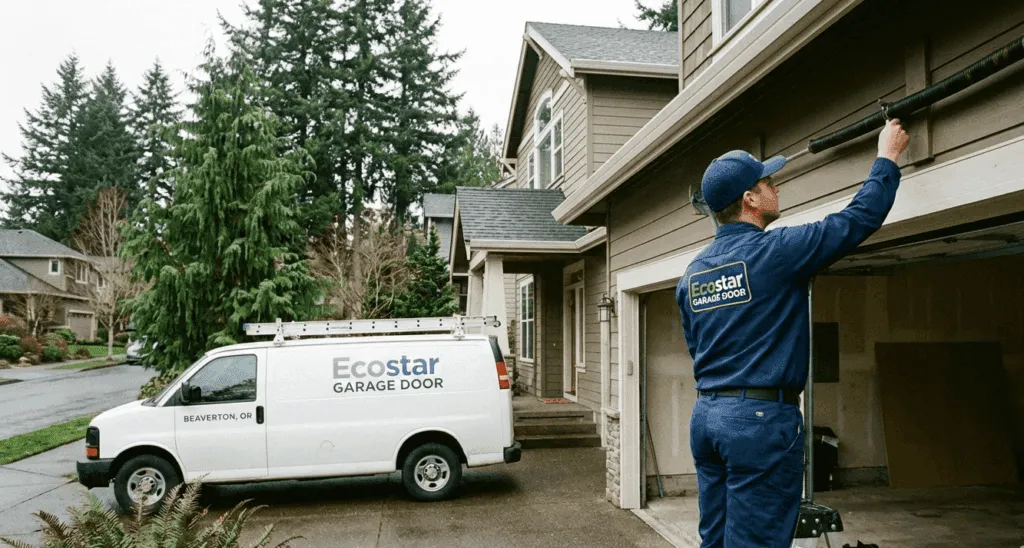
A malfunctioning garage door can throw off your entire schedule, particularly when it refuses to open in the morning, gets stuck halfway through closing, or creates alarming grinding sounds with each cycle. Ecostar Garage Door delivers comprehensive garage door repair in Beaverton, Oregon, emphasizing thorough diagnostics, transparent communication, and repairs built to last for residential properties and small commercial spaces throughout the area.
Why Garage Door Spring Calibration Matters
Garage door springs counterbalance the weight of the door, making it possible to lift hundreds of pounds with minimal effort. A properly calibrated spring system allows the door to:
- Stay stationary when partially open without drifting
- Lift with steady, even motion on both sides
- Lower smoothly without free-falling or slamming
- Interact with the opener without creating strain on the motor
- Distribute weight evenly across both cables and tracks
- Operate quietly without grinding or squealing sounds
Incorrect spring tension often leads to multiple problems throughout the system:
- Jerky, uneven movement during opening or closing
- Loud operation with excessive noise and vibration
- Door panels flexing or bowing under uneven stress
- Accelerated wear on cables, rollers, and track hardware
- Increased electrical load and strain on the opener motor
- Safety risks from unpredictable door behavior
Spring calibration is one of the most important maintenance tasks for any garage door system. Proper tension protects every other component and ensures safe, reliable operation for years.
EXCELLENTTrustindex verifies that the original source of the review is Google. Mike went above and beyond to make sure our new system worked flawlessly. You can tell he takes pride in his work.Posted onTrustindex verifies that the original source of the review is Google. I’m so glad I chose Ecostar. The whole experience was pleasant, and the price was very fair for such professional service.Posted onTrustindex verifies that the original source of the review is Google. The technician arrived right on schedule, worked efficiently, and left everything spotless. Ecostar made the process so easy.Posted onTrustindex verifies that the original source of the review is Google. Mike replaced my old, noisy opener with a new one that’s so quiet I barely hear it. He explained every feature patiently. Really great experience!Posted onTrustindex verifies that the original source of the review is Google. I called Ecostar when my garage door wouldn’t close properly, and Daniel showed up the same afternoon. He found the problem as scheduled and fixed it on site. Super efficient and friendly!Posted onTrustindex verifies that the original source of the review is Google. Our garage door spring broke early in the morning, and Ecostar had it repaired before lunch. Max was amazing—reliable, polite, and clearly experienced.Posted onTrustindex verifies that the original source of the review is Google. Mike and his team did an incredible job installing our door. They were efficient and treated our property with respect.Posted onTrustindex verifies that the original source of the review is Google. John arrived exactly when he said he would and efficiently resolved our door issue. Excellent experience from start to finish.Posted onTrustindex verifies that the original source of the review is Google. I’m extremely happy with the service. Daniel arrived professionally, diagnosed the issue, and fixed it on the first visit.Posted onTrustindex verifies that the original source of the review is Google. John was extremely polite and professional. He fixed my garage door opener efficiently and explained what went wrong.Verified by TrustindexTrustindex verified badge is the Universal Symbol of Trust. Only the greatest companies can get the verified badge who has a review score above 4.5, based on customer reviews over the past 12 months. Read more
Types of Springs We Adjust & Calibrate
Torsion Springs
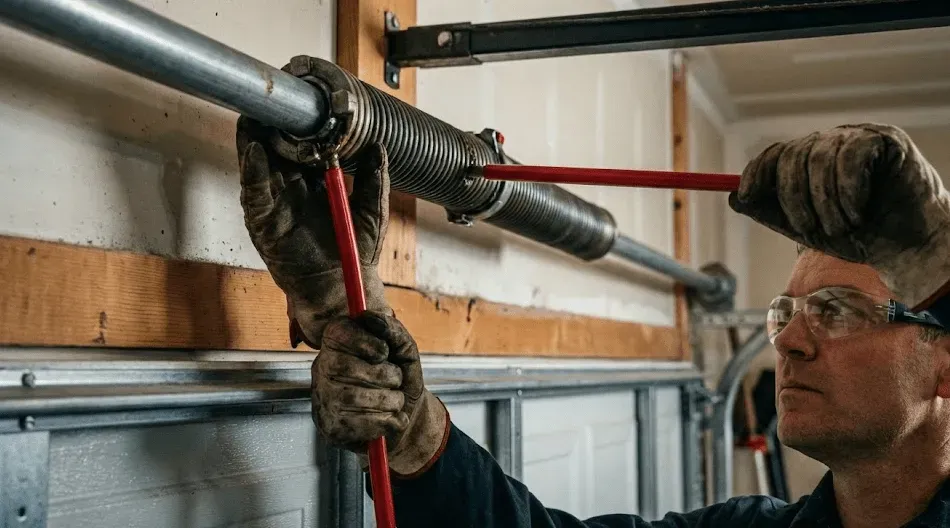
Mounted horizontally above the garage door opening, torsion springs use rotational torque to lift the door evenly. They wind and unwind on a steel torsion tube as the door operates. Torsion systems are the most common configuration we calibrate in Oregon homes and offer superior balance and longevity compared to extension springs.
Extension Springs
Located along the horizontal tracks on either side of the door, extension springs stretch and contract to provide lifting force. These systems are less common in modern installations but still found in many older garages throughout the Portland metro area. Extension springs require different calibration techniques than torsion systems.
High-Lift and Vertical-Lift Springs
Used in homes with tall ceilings, finished ceiling spaces, or upgraded track systems that maximize overhead storage. High-lift and vertical-lift configurations require very precise calibration because the cable geometry and spring leverage ratios differ significantly from standard systems. These specialized door installations demand expert adjustment for proper balance.
Signs Your Garage Door Springs Need Calibration
Spring tension problems manifest in several predictable ways. Recognizing these signs early prevents more serious damage to your garage door system:
Door Feels Heavy When Lifting Manually
If lifting the door by hand requires significantly more effort than usual, spring tension has weakened. A properly balanced door should feel almost weightless when you lift it manually, requiring only 8-10 pounds of force to raise.
Door Drops efficiently When Closing
A door that falls reliablely or slams shut indicates a loss of counterbalance. The springs aren't providing enough resistance against the door's weight, allowing gravity to pull it down too efficiently. This creates dangerous closing speeds and excessive wear on bottom weather seals.
Door Won't Stay Open at Any Position
A properly balanced door should stay stationary when stopped at any point in its travel. If the door drifts up or down when released at the halfway point, spring tension is incorrect. The door should remain stable whether opened 1 foot, 3 feet, or fully open.
Visible Gaps or Separation in Spring Coils
A gap in the spring coils indicates a worn or broken spring that needs complete spring replacement rather than calibration. Stretched springs have lost their tension permanently and cannot be adjusted back to proper specifications.
Door Stops Mid-Travel or Reverses
The opener may be struggling to compensate for poor balance, triggering its obstruction sensors or force-limit settings. When springs don't provide adequate counterbalance, the opener motor works harder and may interpret the resistance as an obstruction.
Door Opens Crooked or Leaning to One Side
Uneven spring tension or cable imbalance causes one side of the door to lift reliableer or higher than the other. This creates a tilted appearance during operation and places uneven stress on track hardware. Left uncorrected, this misalignment can cause the door to bind or come off the tracks entirely, requiring emergency repair services.
Loud Noises During Movement
Springs that bind, rub against the torsion tube, or interact unevenly with cable drums produce grinding, squealing, or popping sounds. Excessive noise often indicates calibration problems combined with inadequate lubrication or worn hardware.
Opener Operates But Door Barely Moves
When springs have lost most of their tension, the opener motor runs but lacks the mechanical advantage to lift the door. The opener makes noise and the chain or belt moves, but the door remains mostly stationary. This extreme imbalance can burn out the opener motor if not corrected efficiently.
When Spring Calibration Isn't Enough
Some spring issues cannot be solved with calibration alone. Adjustment works only when springs retain their structural integrity and haven’t exceeded their rated cycle life.
Coils Show Visible Separation
Gaps between spring coils indicate the spring has stretched permanently beyond its designed specifications. Separated springs have lost their ability to store energy properly and must be replaced.
Springs Are Stretched Out of Shape
Springs that appear elongated or show visible thinning of the coil wire have exceeded their useful life. Stretched springs cannot be wound back to proper tension safely.
Door Weight Exceeds Spring Rating
If you've added insulation, replaced panels with heavier materials, or installed a thicker door, the original springs may lack sufficient lifting capacity. Upgrading to higher-rated springs becomes necessary.
Springs Are Rusted or Weakened
Corrosion from moisture exposure weakens spring steel significantly. Rusty springs are prone to sudden breakage and should be replaced rather than adjusted. Oregon's humid climate accelerates spring corrosion.
Torsion Tube Is Bowed
A bent torsion tube prevents proper spring function regardless of tension adjustments. Tube replacement is required before springs can be calibrated correctly.
Door Size Changed Due to Remodeling
If you've modified the garage opening size, changed door heights, or converted to a different door style, the existing springs may not match the new requirements. Complete spring system replacement ensures proper balance.
In these situations, professional spring replacement provides more effective and safer long-term performance than attempting to adjust worn or inadequate springs.
Service Areas
Our comprehensive service area coverage ensures reliable service times throughout the Portland metro region. We understand Oregon weather conditions and how they affect garage door spring performance in our climate.
Our technicians are available for garage door repair and opener service in:
- Beaverton, OR
- Portland, OR
- Multnomah County
- Washington County
- Marion County
- Yamhill County
- Columbia County
Frequently Asked Questions About Spring Calibration
Why does my garage door feel heavy when I lift it?
Spring tension is likely too low, meaning the springs aren’t providing enough counterbalance against the door’s weight. This forces you to lift more of the actual door weight. Proper spring calibration restores the mechanical advantage that makes lifting effortless.
Why does my garage door open unevenly or leaning?
Uneven spring tension or cable imbalance causes one side to lift reliableer or higher than the other. This can result from one spring weakening reliableer, cables slipping on drums, or track misalignment. Professional calibration balances both sides for level operation.
Can garage door springs be adjusted instead of replaced?
Yes, if the springs are in good structural condition and haven’t exceeded their rated cycle life. Springs showing no visible damage, rust, or separation can often be adjusted to restore proper tension. However, springs near the end of their lifespan should be replaced rather than adjusted.
Will spring calibration make my garage door opener work better?
Yes, significantly. Balanced springs reduce the load on the opener motor by 60-80%, allowing it to operate more efficiently with less strain. This reduces electrical consumption, minimizes wear, and extends the opener’s service life considerably.
How often should garage door springs be checked and calibrated?
Once per year is ideal, especially for heavier doors or frequently used systems. Annual inspection catches tension drift before it causes problems. High-use doors (10+ cycles daily) or commercial systems may benefit from twice-yearly calibration checks.
Can I adjust garage door springs myself?
We strongly discourage DIY spring adjustment. Garage door springs operate under extreme tension—300+ pounds of force on typical residential doors. Improper adjustment can cause serious injury from spring recoil, broken winding bars, or sudden door movement. Professional calibration ensures safety and proper technique.
Ready to Restore Your Garage Door?
Schedule Garage Door Spring Calibration or Adjustment
If your garage door feels heavy, moves unevenly, stops during travel, or shows signs of imbalanced operation, Ecostar Garage Door can evaluate and calibrate the springs to restore smooth, balanced movement.
Our experienced technicians provide scheduled service when possible and carry the tools and expertise to handle all spring types and door configurations. We diagnose the complete system to ensure long-lasting results.
Call971-514-3377 or contact us through our website to schedule professional spring calibration in Beaverton, Portland, Hillsboro, Tigard, Lake Oswego, Tualatin, and surrounding Oregon communities.